1998, and nobody could fight in 3D
When games made the jump from 2D to 3D in the mid-90s, almost everything got harder — and combat got worse. In 2D, an enemy was simply to your left or your right. In 3D, where is it? Behind you? Above you? Your sword swings into empty air, the camera spins, and you spend the fight wrestling the controls instead of the monster.
Then, in 1998, The Legend of Zelda: Ocarina of Time walked in and quietly solved the entire problem with one button. It was called Z-Targeting, and there was genuinely nothing like it. Almost every 3D action game you've played since is built on top of it.
The problem Zelda had to solve
Ocarina of Time was Zelda's first step into 3D, and the team faced a brutal design question: how do you make a sword fight feel good when the enemy can be anywhere in a 3D space?
Every option on the table was bad:
- Free aiming was fiddly and slow — you'd never land a hit in real time.
- Auto-facing the nearest enemy was unpredictable and stole control from the player.
- A fixed camera made it impossible to see what mattered.
Combat in early 3D games failed not because the fighting was shallow, but because players couldn't read the space. Zelda's breakthrough wasn't a better sword — it was a way to make 3D legible.
The solution: press Z, and the world reorganizes
Here's the magic. You press Z, your fairy companion Navi darts to the nearest enemy, and you lock on. In that instant, three things happen at once:
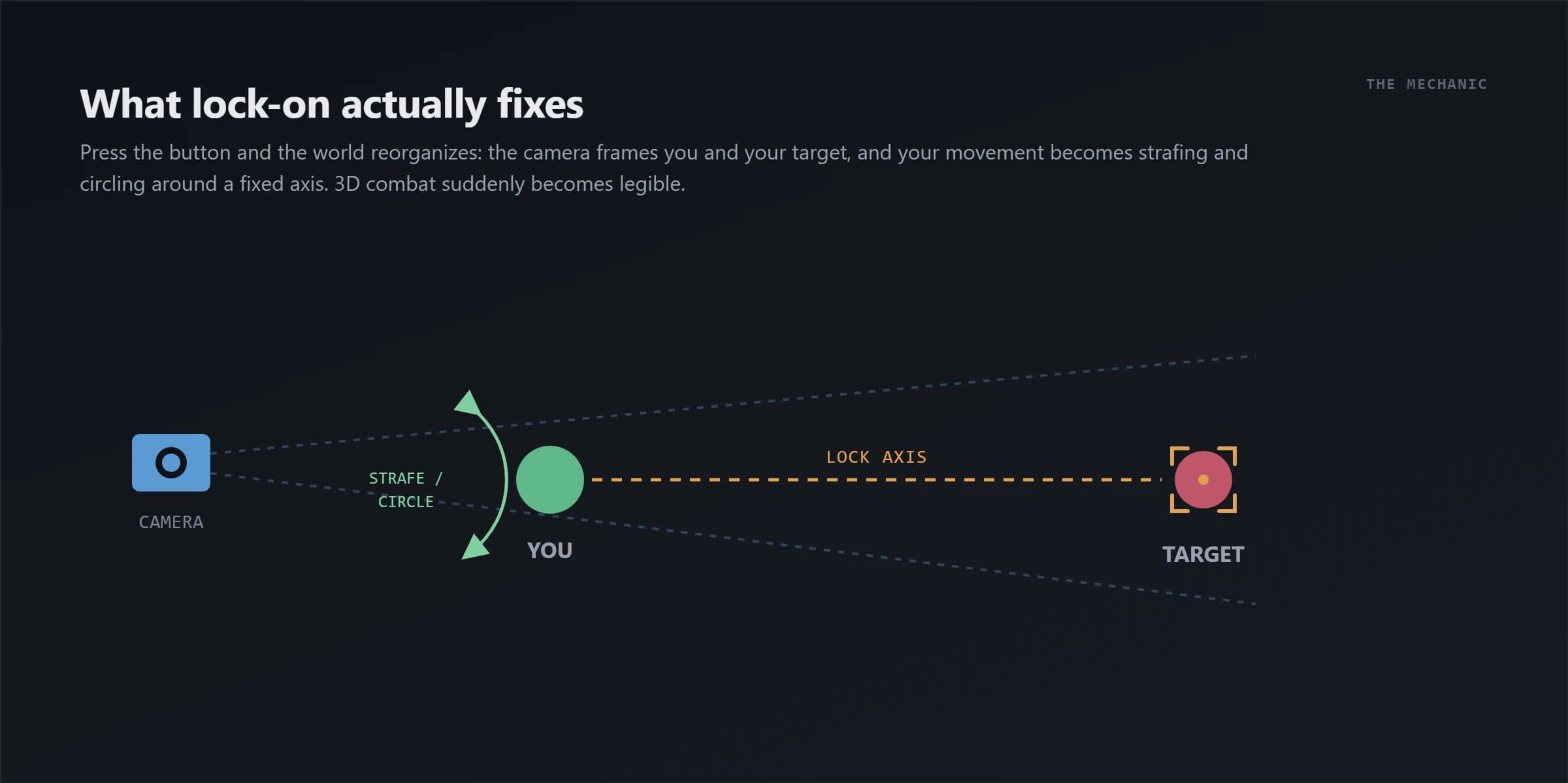
- The camera snaps to frame both you and your target. You can always see the fight.
- Link auto-faces the enemy. Your sword now always swings at the thing you're fighting.
- Your movement transforms. Instead of running around blindly, you now strafe and circle around a fixed axis — sidehop left, backflip away, raise your shield to deflect.
Suddenly a 3D duel feels as readable as a 2D one. The genius detail is Navi: a glowing, unmissable marker that tells you exactly what you're locked to. The game offloaded all the spatial confusion onto one tiny, charming UI element. That's not a combat feature — that's an interface invention.
And it scaled to everything: aiming the slingshot, grappling with the Hookshot, talking to a character, reading the room in a puzzle. One button made the whole 3D world snap into focus.
Why there was nothing like it
It's hard to overstate how unsolved this was in the 90s. Other 3D games of the era either avoided real-time melee, leaned on clumsy auto-aim, or simply made you suffer the camera. Z-Targeting didn't just improve 3D combat — it set the template the entire genre would copy. It defined the grammar of how a character, a camera, and a target relate in 3D space.
The inheritance: one root, a whole genre
Z-Targeting never stayed in Hyrule. Look at almost any 3D action game since and you'll find its fingerprints — sometimes renamed, never replaced.
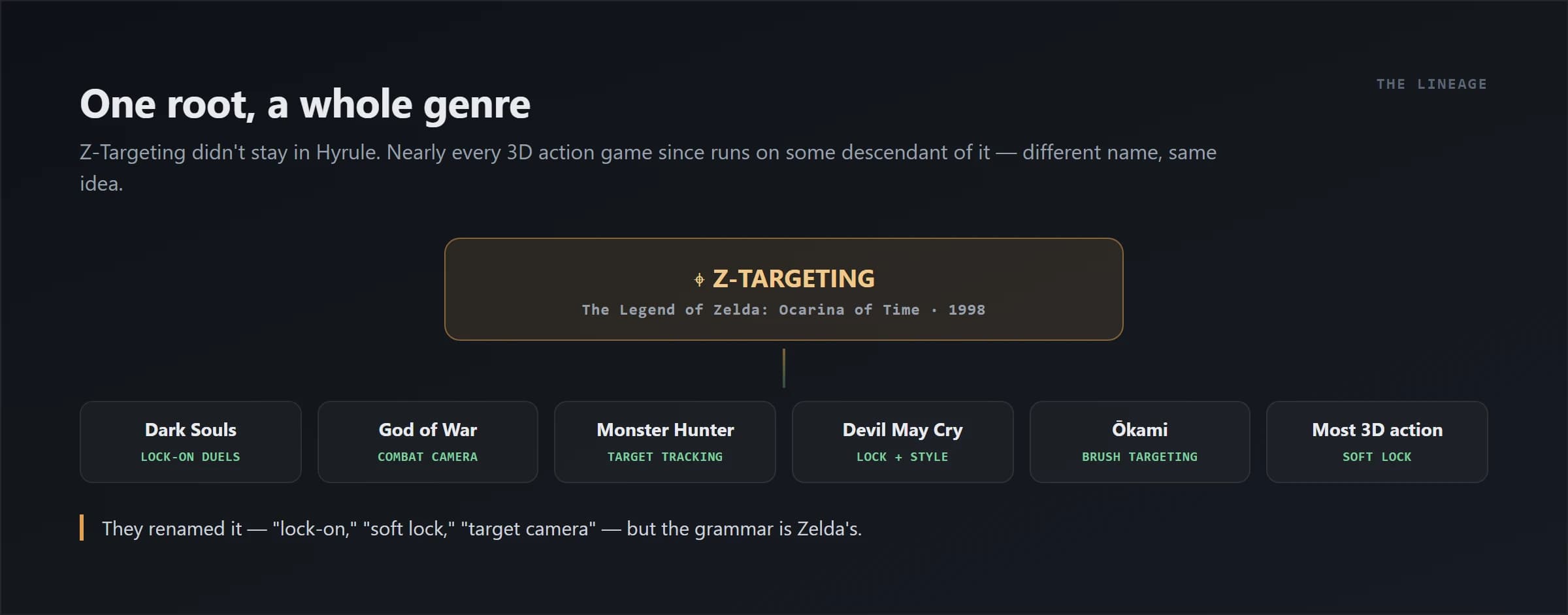
- Dark Souls built its tense, deliberate duels on lock-on circling — pure Z-Targeting DNA.
- God of War (2018) frames its whole over-the-shoulder combat around a locked target.
- Monster Hunter lives and dies by target tracking against huge enemies.
- Devil May Cry layered its style system on top of lock-on.
- Ōkami — itself deeply Zelda-inspired — uses targeting for its brush techniques.
- And countless action games use a soft lock that quietly snaps you toward the nearest threat.
They call it "lock-on," "soft lock," "target camera." But the underlying idea — fix an axis between fighter and target, let the camera and movement reorganize around it — is Zelda's.
The real design lesson
Here's what's worth stealing from Ocarina of Time, whatever you're building:
The hardest problems in 3D aren't about mechanics — they're about legibility. Z-Targeting won because it made a confusing space instantly readable, and pushed all that complexity onto one clear signal (a fairy).
When players feel like a system is "clunky," it's usually not too shallow — it's illegible. The fix is rarely more depth; it's a clearer way to read the situation. Zelda solved a combat problem with a UI idea, and that's why it generalized to an entire genre.
Conclusion: a debt to Hyrule
Ocarina of Time is remembered for its world, its music, its dungeons. But its quietest contribution might be the most far-reaching: a single button that taught the whole industry how to fight in three dimensions. Every time a modern game snaps its camera to a boss and lets you circle, strafe and strike, you're watching a 27-year-old idea still doing its job.
There was nothing like it in the 90s. And there's a little bit of it in almost everything since.
Want to actually build a lock-on system? LOCK-ON — Designing Target-Lock Combat for 3D Action Games is the complete guide: hard vs soft lock, the lock-on camera (the hard part), target acquisition and switching, locked movement and attacks, the reticle and feedback, and a full tuning checklist — the whole system Zelda pioneered, decision by decision, for your own game.