Flowers are everywhere — and almost always wallpaper
Open nearly any game and you'll find flowers. In the grass, on the menus, in the loading screens. But in 99% of games they're set-dressing — pretty pixels you walk past. A small group of games does something far more interesting: they turn the flower into the mechanic itself. The flower stops being decoration and starts being a verb.
This is a quick tour of the games that did it — ranked by how deep the flower goes — ending with the one that, quietly, does it best.
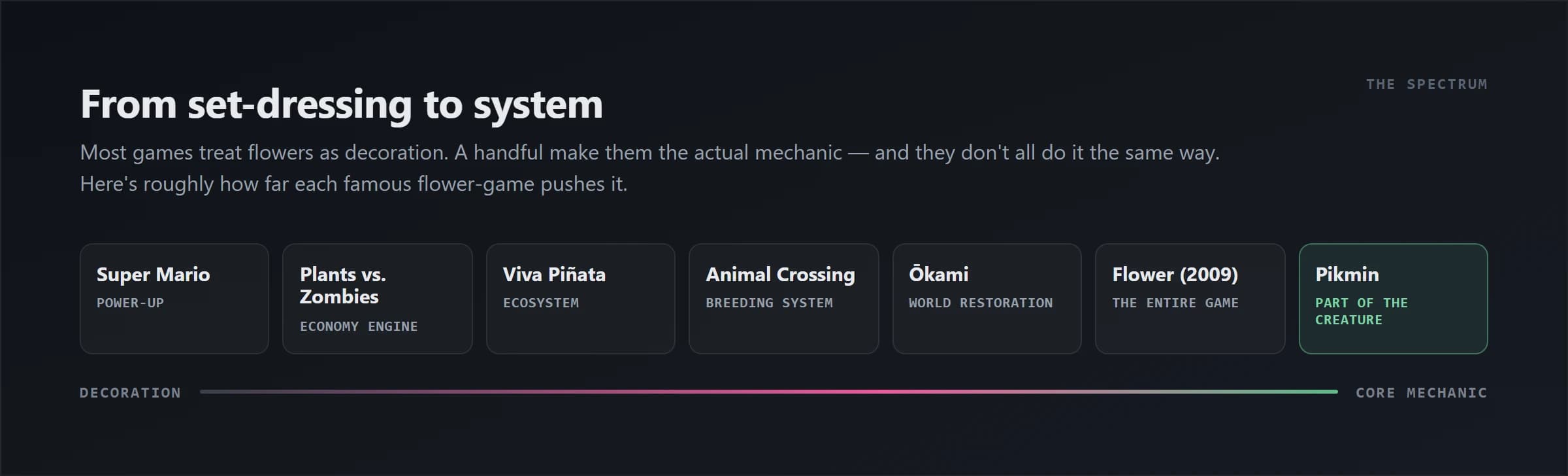
The roll call
—Super Mario — the flower as a power-up
The most famous flower in all of gaming is the Fire Flower. Since 1985, touching it transforms Mario and lets him throw fireballs; the Ice Flower later did the frozen version. It's iconic, but mechanically the flower is a switch — grab it, get an ability. Flower-as-button. Shallow, but unforgettable.
—Plants vs. Zombies — the flower as an economy
The Sunflower isn't a weapon — it's your bank. It generates the sun you spend on everything else, which makes it the quiet backbone of the entire game. Here the flower is an engine: a resource generator the whole strategy is built around.
—Viva Piñata — the flower as an ecosystem
In Rare's garden sim, you grow flowers and plants to attract and breed the piñata creatures. The flower is no longer a single object but a system input — change the garden, change which animals show up. Flower-as-ecosystem.
—Animal Crossing — the flower as genetics
Animal Crossing (especially New Horizons) turns flowers into a full breeding meta-game. Cross-pollinate the right colors and you get hybrids; chase the elusive blue rose and you're basically doing Mendelian genetics in a cute town. The flower becomes a system you cultivate over weeks.
—Ōkami — the flower as restoration
As the sun goddess Amaterasu, you literally revive nature: your "Bloom" brush technique bursts dead landscapes into flowers and blossoms. The flower here is the language of the entire game — your progress is measured in how much of the world has bloomed back to life.
—Flower (2009) — the flower as emotion
thatgamecompany's Flower is the purest case: you're the wind, carrying a stream of petals across fields, blooming flowers as you drift. No words, no UI, no fail state — just flowers as a wordless emotional arc. The flower isn't a mechanic here; it's the whole game.
Honorable mentions: Botany Manor (a puzzle game entirely about growing rare plants), Stardew Valley (flowers that flavor your honey), and Hanafuda — the literal "flower cards" Nintendo was founded making in 1889.
And then there's Pikmin
Every game above treats the flower as something external: a power-up you grab, a resource you farm, a world you restore. Pikmin does something none of them do — it puts the flower inside the creature.
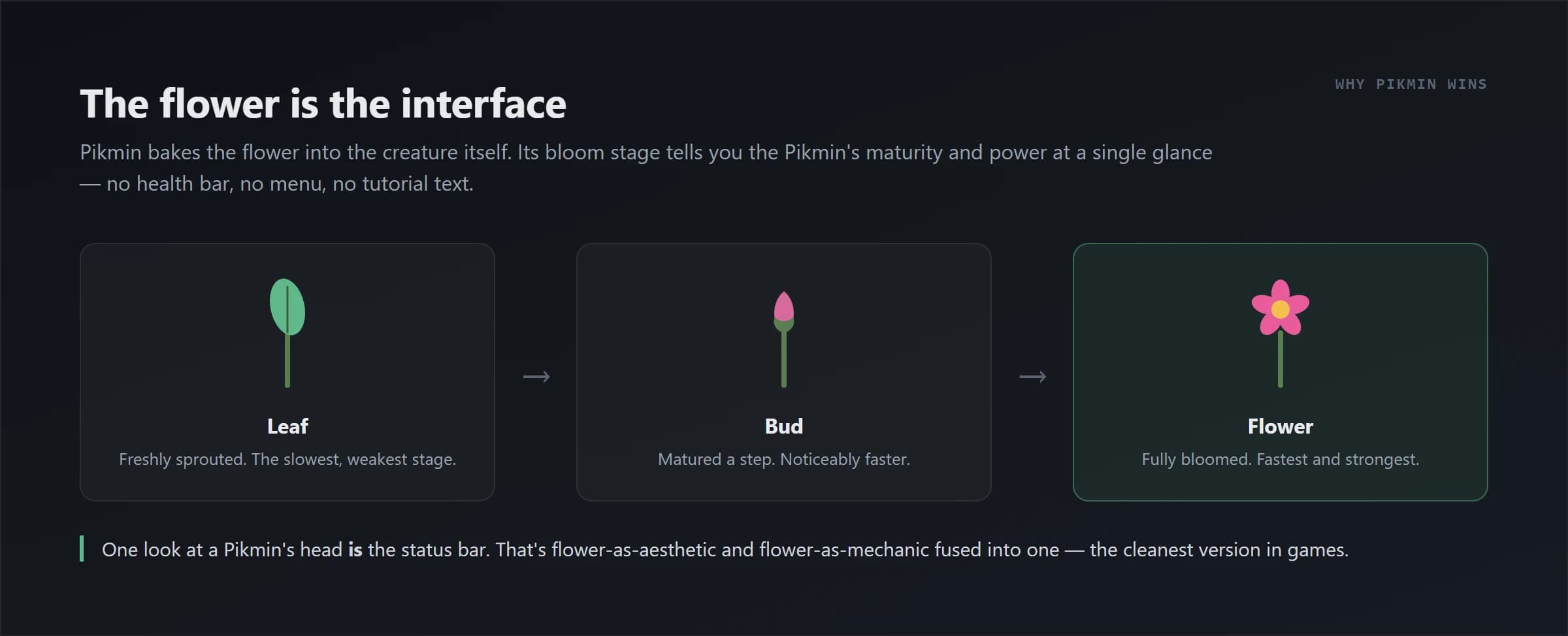
Every Pikmin grows a leaf, then a bud, then a flower on its stem as it matures — and that bloom stage isn't cosmetic. Flower Pikmin move faster and fight harder. Which means a single glance at a Pikmin's head tells you its power level. No health bar. No menu. No tutorial pop-up.
That's the trick that makes it the best: Pikmin fuses the two things every other game keeps separate — flower-as-aesthetic and flower-as-mechanic — into one object. The flower is the status bar. It's diegetic UI: information delivered entirely through the world, charming and functional at the same time.
It's also emotionally sticky. Watching your little squad bloom from leaves into flowers feels like growth — you're not reading a number going up, you're watching a garden mature. That's something a Fire Flower or a sun counter can never do.
The design lesson
The thread running through all of these is a single, reusable idea:
Take something players treat as decoration, and make it carry information or consequence.
A flower can be a power-up, an economy, an ecosystem, a genetics system, or a feeling. The best version — Pikmin's — does the rarest thing of all: it makes the decoration and the mechanic the same object, so the game teaches you through the world instead of through a UI. That's a principle you can lift into any genre, flowers or not.
So, who does it best?
Flower is the most artful, Plants vs. Zombies the most mechanically central, Animal Crossing the deepest system. But Pikmin wins because it makes the flower do the most jobs at once — power indicator, progression, charm, and interface — without ever showing you a stat. That's flower power.
All this flower talk got you wanting to make your own? Sutera Cordata — 20,000+ AI Art Prompts turns one delicate bloom into 20,000+ ready-to-paste prompts across 22 styles — watercolor, woodblock, stained glass, low-poly and more — for Midjourney, Stable Diffusion, DALL·E and the rest.