The dream and the freeze
Almost everyone who has played Super Smash Bros. has had the thought: "I could make my own." Then they open a blank project — and freeze. A platform fighter looks simple from the couch, but under the hood it's a deep, interlocking machine of percent, knockback, recovery, frame data and rosters.
So here's the real question, answered honestly: can one person actually build a game like this?
The short answer
Yes — but only if you respect the scope and ruthlessly cut what you don't need.
The platform-fighter genre is well within reach for a solo or tiny-team developer. It is a legal, established genre (Rivals of Aether, Brawlhalla, MultiVersus and others all exist), the core mechanics are well understood, and modern engines do most of the heavy lifting. What kills solo projects isn't the genre — it's scope creep and trying to build everything at once.
Let's look at what "everything" actually is.
What a platform fighter actually needs
This is the honest scope. A platform fighter isn't one system — it's five interlocking systems, and they all have to feel good together.
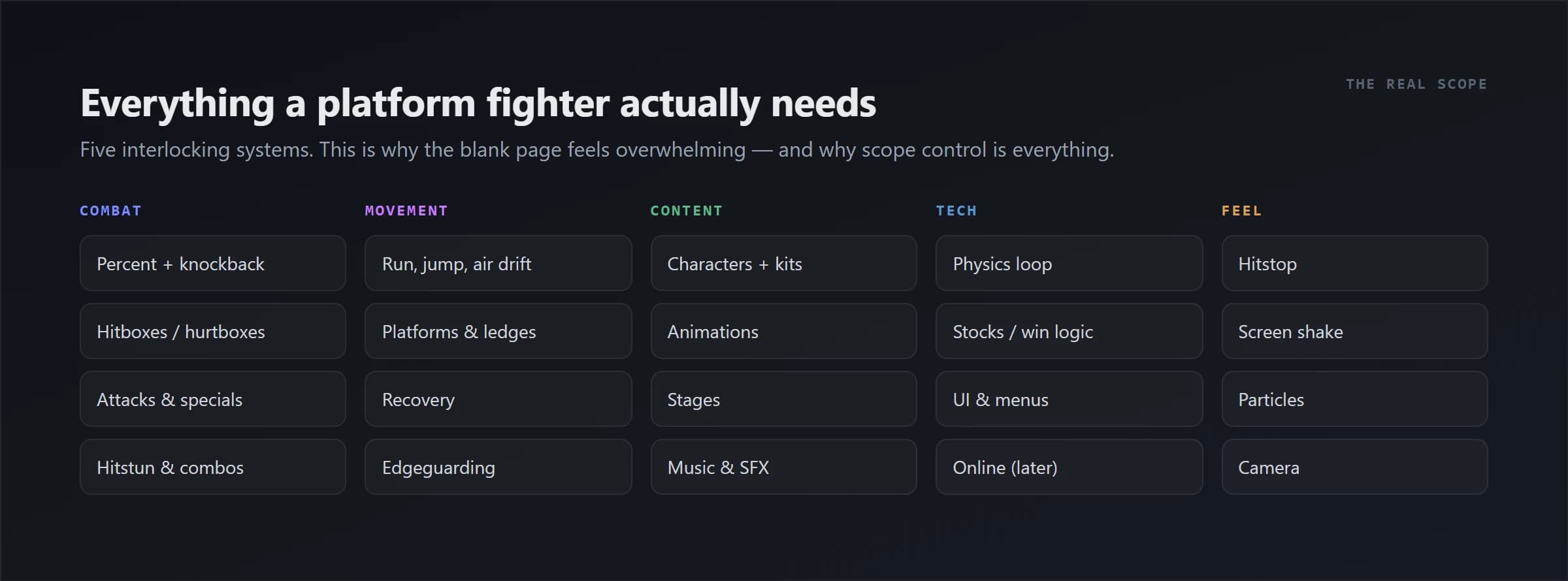
- Combat — the percent + knockback model, hitboxes, attacks, specials, hitstun and combos.
- Movement — running, jumping, air drift, platforms, ledges, and the all-important recovery and edgeguarding.
- Content — characters and their kits, animations, stages, music and sound.
- Tech — the physics loop, stock/win logic, UI and menus, and (eventually) online.
- Feel — hitstop, screen shake, particles and camera work. This is what makes a hit land with weight.
The reason the blank page feels overwhelming is that all five are visible at once. The secret is that you don't build them all at once.
Why it's harder than a "normal" game
Be honest with yourself about the two genuine difficulties:
- Everything depends on feel. A platformer can be "fine." A fighting game that feels mushy is dead on arrival. You will spend a lot of time tuning knockback, hitstun and hitstop until a single hit feels right.
- Content volume scales fast. Every character needs a full moveset and animations. Two characters is roughly twice the art and twice the balancing. This is the trap that turns a 3-month project into a 3-year one.
And one thing you can postpone: online netcode is the hardest part of the entire genre. Rollback netcode is a specialist discipline. Leave it for last — or skip it entirely for v1.
Why it's more achievable than it looks
It's not all bad news. Several things tilt the odds back toward a solo dev:
- The genre is solved. You're not inventing mechanics from scratch — you're adapting a proven design. This guide and others map the blueprint.
- You can cut online. A great local-multiplayer platform fighter is a complete, shippable game.
- A tiny roster is fine. Two well-designed characters beat eight half-baked ones. Rivals of Aether launched its early access with a handful.
- Greyboxing gets you playing fast. Boxes and capsules let you find the fun before you draw a single sprite.
- Engines do the math. Godot and Unity both handle physics, input and rendering, so you focus on design.
A realistic solo build order
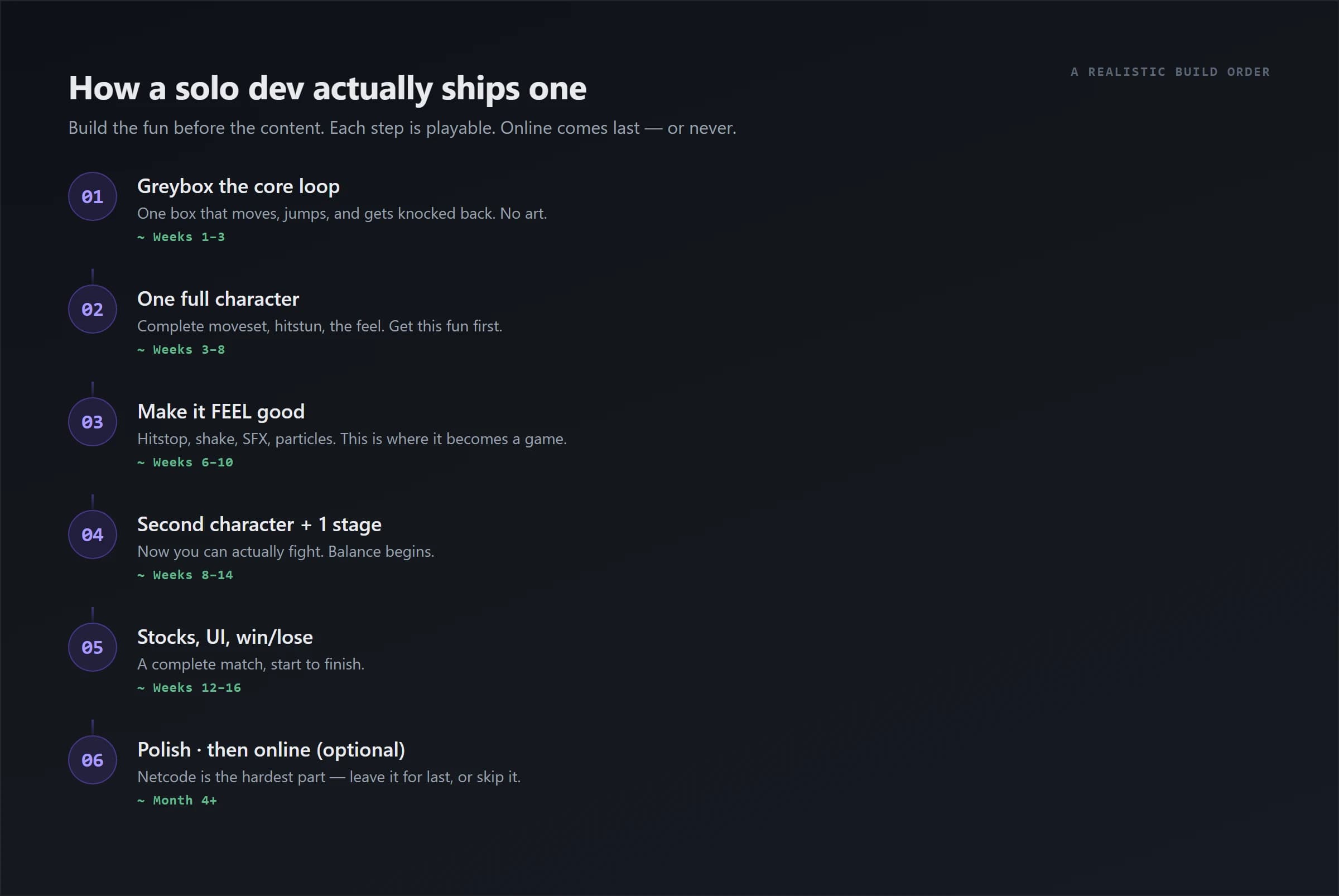
Here's the part that actually matters: the order you build in. Build the fun before the content, and keep every step playable.
The logic:
- Greybox the core loop first. One box that moves, jumps and gets knocked back. No art at all.
- Get one character genuinely fun before making a second. If one character isn't fun, ten won't be either.
- Make it feel good early — hitstop, shake, SFX. This is where a tech demo becomes a game.
- Only then add a second character and a stage — now you have a real fight, and balancing begins.
- Online comes last, if at all.
What to cut ruthlessly
Scope control is the skill. For a solo v1, cut:
- Large rosters (start with 2–3)
- Online multiplayer (local first)
- Story/adventure modes
- Dozens of stages (one or two clean ones)
- Items and gimmicks (add after the core is fun)
- Unlockables, cosmetics, progression
You can always add. You can rarely finish if you start with everything.
Realistic timelines
No false promises. As a rough guide for a solo dev working steadily:
- A fun, juicy one-character prototype: ~1–2 months
- A playable two-character, one-stage build: ~3–4 months
- A small, polished, releasable local game: ~6–12 months
- Add competitive online: significantly more, or a second person
These compress with experience and stretch with ambition. The number that matters most is how aggressively you cut.
The one thing that makes or breaks it
Solo platform fighters don't usually die from a hard problem. They die from no plan and too much scope — building three characters before any of them is fun, chasing online too early, polishing menus before the combat works.
A solo dev who scopes tightly and builds in the right order can absolutely ship a platform fighter. One who tries to build their dream Smash-killer on day one almost never does.
Design your own game, not Nintendo's. The genre is free to build in — the characters, names and art are not. Make your own original fighters and you stay completely in the clear.
The honest verdict
Yes, one person can make a platform fighter — a focused, local-multiplayer one with a small roster, built in the right order. It's a real challenge, but a bounded one. The deciding factor isn't talent or engine choice. It's scope discipline and a clear build plan.
If you've decided you're going to do it, the next step is turning that decision into an actual design: the combat math, a repeatable character-design framework, balancing without a math degree, and a build roadmap that ships.
Want the full blueprint? RING-OUT — How to Design a Platform Fighter is the complete playbook: the percent/knockback model explained, a fill-in character-design framework, balancing know-how, and a concrete prototype build order — everything in this article, taken all the way to a design you can build.